
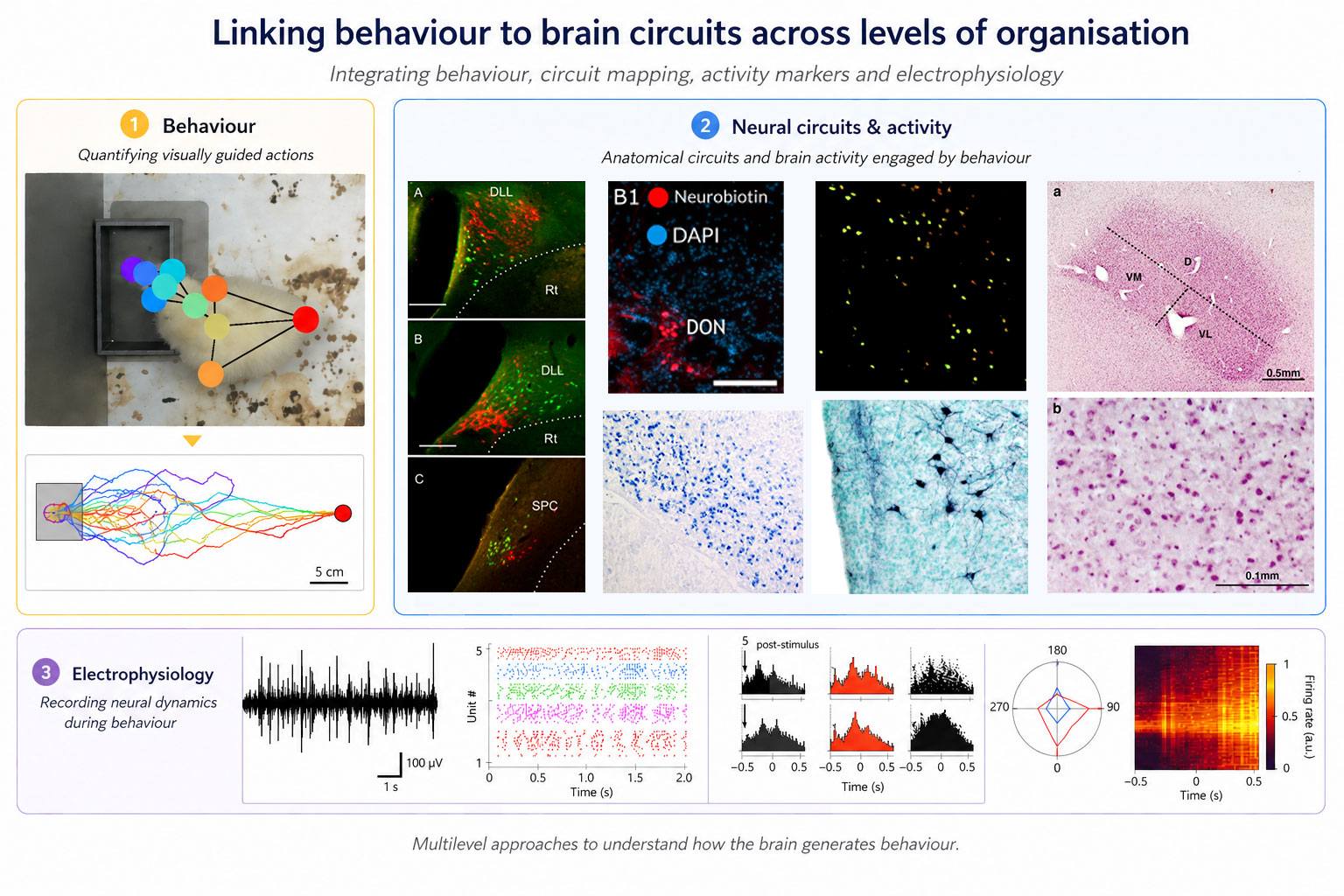
Understanding how brain circuits generate behaviour requires combining approaches across multiple levels of organisation. In our group, we integrate behavioural analysis, circuit-level mapping, electrophysiology, and molecular profiling to study how neural systems control behaviour in avian models.
Behavioural analysis
We design controlled behavioural paradigms to quantify both spontaneous and learned responses in domestic chicks. These paradigms allow us to characterise the structure and dynamics of visually guided behaviours and to link them to underlying neural processes.
Circuit mapping and neuroanatomy
We use histological and neuroanatomical techniques to identify and localise brain regions and pathways involved in behaviour. This includes stereotactic targeting and anatomical reconstruction to relate functional data to defined neural circuits.
Activity mapping (immediate early genes)
We employ brain activity mapping based on immediate early gene expression (e.g. c-Fos) to identify neuronal populations engaged during specific behavioural tasks. This approach allows us to link behaviour to distributed circuit activation patterns.
Electrophysiology
We perform extracellular recordings to characterise neural response properties and coding dynamics in identified brain regions, including the visual pallium. These recordings provide high temporal resolution insights into how sensory information is transformed into behaviourally relevant signals.
Connectivity and perturbation
We combine anatomical tracing and targeted manipulations (e.g. lesions or focal inactivation) to investigate how specific circuits contribute causally to behaviour and to map functional interactions between brain regions.
Molecular profiling
We use transcriptomic approaches to identify cell types and molecular signatures associated with specific circuits, enabling a link between functional activity and cellular identity.